
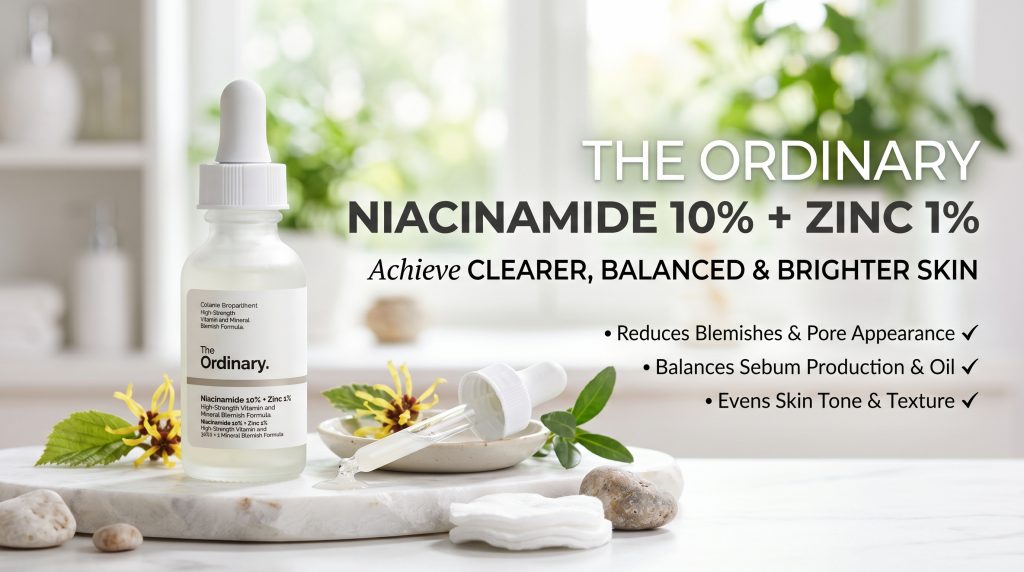
The Ordinary Niacinamide 10% + Zinc 1% is an affordable, lightweight serum designed primarily to help clear up oily and blemish-prone skin.
What it does: The serum works to reduce excess oil, make enlarged pores look smaller, and give the skin a smoother, brighter appearance. It is also great for calming down redness and reducing the frequency of new acne breakouts. As an added bonus, it helps strengthen your skin’s natural protective barrier so it can hold onto moisture better.
Who it is for: This product is best suited for people with oily, combination, or acne-prone skin. Because the formula is quite strong, it might be too harsh and cause irritation for those with very sensitive or extremely dry skin.
How to use it: You only need to apply two to three drops to your face after cleansing, but before applying any heavier moisturizers or creams. One important rule to remember is that you should not use this serum at the exact same time as Vitamin C products.
What to expect: While your skin might look a bit more radiant right away, this isn’t an overnight magic fix. It usually takes about three to eight weeks of consistent use to see significant changes like reduced oiliness and fewer breakouts. You should also be aware that because the formula is strong, some users experience a temporary phase of mild irritation or a brief increase in breakouts (often called “purging”) as their skin adjusts to the product.
The Unspoken Rules of The Ordinary’s Niacinamide: Why 10% Might Be Too Much—and How to Use It Right
1. Introduction: The Cult Favorite Under the Microscope
It is the $6 bottle that launched a thousand “skin transformations.” The Ordinary’s Niacinamide 10% + Zinc 1% has achieved a level of cult status rarely seen in the beauty world, promising to refine pores, vanish shine, and clear congestion. Yet, for every user who claims it gave them “glass skin,” another reports a sudden, frustrating breakout. Why does this minimalist serum produce such polarizing results?
At its core, this is a high-strength vitamin and mineral blemish formula. Niacinamide, also known as Vitamin B3, is a water-soluble active celebrated for its versatility, while Zinc PCA (the salt of Pyrrolidone Carboxylic Acid) acts as a specialized sebum regulator. To unlock the benefits without the backlash, you need to understand the “unspoken rules” of this potent formulation.
2. The 10% Paradox: When “More” Might Be Too Much
In the world of skincare marketing, we are often led to believe that higher percentages equal faster results. However, the 10% concentration in this serum presents a paradox. Most clinical research demonstrating the efficacy of niacinamide—specifically its ability to fade hyperpigmentation and reduce acne—utilizes concentrations between 2% and 5%.
By doubling that standard, The Ordinary offers a dose that can be a double-edged sword. For some, this potency triggers significant irritation rather than healing. As Dr. Ingky explains in his analysis of the formula:
“At 10% of niacinamide it irritates the epidermal layer of the skin and even though it’s meant to repair skin barrier due to the skin irritation it breaks up the skin barrier leading your skin to be making your skin red itchy irritable and eventually causing acne to appear.”
Expert Analysis: The Dilution Trick and the “Gentle Pivot” If you find the 10% strength causes tingling or redness, don’t toss the bottle yet. You can “buffer” the serum by mixing one or two drops into your favorite Hyaluronic Acid serum or moisturizer. This dilutes the concentration while your skin builds tolerance.
However, if your skin simply cannot handle the 10% formula, consider a “Gentle Pivot.” The Ordinary recently introduced the Niacinamide 5% Face and Body Emulsion. This lower concentration is more in line with clinical success rates and offers a much more forgiving entry point for those with sensitive skin.
3. The “Secret” Exfoliant: Is Your Skin Actually Purging?
Niacinamide is generally classified as a soothing, barrier-supporting active. However, it may have a hidden talent that explains why some users experience a “purge” (a temporary increase in breakouts). This is rooted in a specific scientific theory regarding how the ingredient interacts with skin cells.
“It is theorized that niacinamide may improve the texture of skin by speeding up epidermal turnover hence functioning as a mild exfoliant.” (2005 Study, via Cathy on Skincare)
It is important to note that this is a theory used to explain user experiences, as niacinamide is not a traditional chemical exfoliant like an AHA or BHA. If your skin is purging, you will see small red bumps or whiteheads in areas where you normally break out as existing clogs come to the surface. This should clear within six weeks. If you are breaking out in entirely new areas or experiencing persistent itching, you are likely having a bad reaction to the high concentration and should discontinue use.
4. The Vitamin C Conflict: A Non-Negotiable Routine Rule
One of the most frequent questions regarding The Ordinary’s Niacinamide is how to pair it with other heavy hitters. The brand issues a clear directive: Do not use Niacinamide 10% + Zinc 1% in the same routine as Vitamin C.
This includes both Direct Vitamin C (L-Ascorbic Acid) and Indirect Vitamin C derivatives. The concern here isn’t a dangerous chemical reaction, but rather that the two ingredients can interact in a way that reduces the clinical effectiveness of both actives.
Routine Hack: The AM/PM Split You don’t have to choose between these two superstars; you just have to time them correctly:
- Morning (AM): Apply Niacinamide to control oil and protect the barrier throughout the day.
- Evening (PM): Apply your Vitamin C treatment to focus on brightening and repair while you sleep.
5. The “Soap” Effect: Why Your Serum Might Be Foaming
Users often report that the serum “lathers up” or turns white and soapy during application. Some also experience “pilling,” where the product rolls off in small flakes. This is rarely a sign of a defective product; instead, it is usually a result of friction or the serum interacting with other products in your regimen.
To avoid the “soap effect,” switch to a patting motion instead of rubbing, which reduces the friction that causes the water-based formula to foam.
The “2-3 Drop Rule” Pilling is almost always caused by over-application. Because this formula is highly concentrated, use only 2–3 drops for your entire face and neck. Ensure the serum has fully absorbed and the skin no longer feels tacky before moving on to your moisturizer or SPF.
6. Beyond Acne: The Unsung Hero of Skin Hydration
While the “Zinc” in the name often attracts those with oily skin, this serum is a powerhouse for hydration. However, there is an important distinction for the savvy consumer to make: while the Bioscientia Medicina study confirms that topical niacinamide is effective for increasing skin hydration in adolescents with acne, the study specifically tested a 4% concentration—not the 10% found in this bottle.
Niacinamide works by stimulating the synthesis of ceramides and boosting Natural Moisturizing Factors (NMF). This strengthens the skin’s ability to retain water and prevents Transepidermal Water Loss (TEWL).
The Dual Action of Niacinamide + Zinc
| Niacinamide Roles | Zinc PCA Roles |
| Barrier Support: Boosts ceramide synthesis to strengthen the lipid barrier. | Sebum Regulation: Balances excess oil production to reduce visible shine. |
| Skin Renewal: Supports efficient renewal to smooth texture and brighten tone. | Niacinamide Booster: Specifically enhances the delivery of niacinamide into the skin. |
| Tone Evening: Targets discoloration before it becomes visible. | Moisture Retention: Uses PCA (a Natural Moisturizing Factor) to lock in water. |
| Pore Appearance: Reduces the look of enlarged pores by keeping them clear. | Antimicrobial: Helps keep skin bacteria in check to support a clearer complexion. |
7. Conclusion: Finding Your Skincare “Sweet Spot”
The Ordinary Niacinamide 10% + Zinc 1% is undeniably a powerhouse, but its high concentration requires “Routine Intelligence.” It is a targeted treatment that works best when applied with moderation and layered with care. By understanding how to dilute the formula, avoiding Vitamin C conflicts, and using the correct application technique, you can turn this cult favorite into a long-term staple.
Are you choosing your products based on the highest percentage, or what your skin barrier actually needs?
The Positives: Transformative for Oily and Acne-Prone Skin For users with oily, combination, or blemish-prone skin who tolerate the formulation well, the serum is often described as a “holy grail”.
- Oil and Acne Control: Users frequently report a noticeable reduction in daytime oiliness and a decrease in the frequency of mild to moderate breakouts.
- Texture and Tone: Many users see significant improvements in their skin texture, noting that their skin feels smoother, pores appear smaller, and hyperpigmentation fades over time, with some even achieving a “glass skin” look.
How Users Are Adapting Because the 10% concentration is so strong, many users have found creative workarounds to make the product tolerable:
- Dilution: To prevent the 10% strength from irritating their skin, some users mix a few drops of the serum directly into their moisturizer or a plain hyaluronic acid serum before applying.
- Reduced Frequency: Users experiencing small bumps or dryness have successfully mitigated these side effects by cutting back their usage from every day to just every other night.
- Switching Products: For those who cannot handle the 10% strength, many end up abandoning the serum entirely in favor of gentler alternatives formulated with a safer 3% to 5% niacinamide concentration.
What skin concerns does the serum address?
The Ordinary Niacinamide 10% + Zinc 1% targets enlarged pores, excess sebum, dullness, and uneven skin texture. It also helps target fine lines and wrinkles, improves plumpness and suppleness, and supports overall skin radiance.
Is it good for acne and blemish-prone skin?
Yes, it is highly suitable for blemish-prone skin. It helps reduce inflammation, balances excess oil production, and addresses signs of congestion, which can lead to a visible reduction in the frequency of breakouts with consistent use.
Which skin types is this product best for?
It performs best for oily, combination, and acne-prone skin. People with very sensitive or extremely dry skin should use it with caution and are advised to pair it with a good hydrating serum or moisturizer to avoid tightness.
How often should I apply it?
You can use it twice daily, in the morning and evening. It is recommended to apply a few drops (2-3 drops) to the face after cleansing and before applying heavier creams or moisturizers
How long does it take to see results?
ou may see a significant improvement in plumpness, suppleness, and skin radiance within 15 minutes, with smoother skin texture becoming noticeable within a week. For more prominent visible improvements like reduced oiliness, fewer breakouts, and reduced pore visibility, it typically takes 3 to 8 weeks of consistent use
Why does the serum feel sticky or pill under makeup?`
Pilling or stickiness can happen if you apply too much product or layer it incorrectly. Using more than 2-3 drops, mixing it with silicone-heavy products, or not letting the serum fully absorb before your next step can cause the products to sit on the skin and pill
Can I use Niacinamide with Vitamin C?
It is not recommended to use niacinamide in the same routine as direct or indirect Vitamin C. Combining them can decrease the effectiveness of both ingredients, so it is best to use them at different times of the day, such as applying your Niacinamide in the morning and your Vitamin C in the evening.
Will this serum cause purging or breakouts?
Some users do report temporary purging or breakouts when introducing the serum to their routine. While niacinamide isn’t a traditional exfoliant, some theories suggest it functions as a mild exfoliant by speeding up epidermal cell turnover, which can bring deep clogs to the surface faster. Alternatively, the high 10% concentration can cause skin irritation in some people, breaking down the skin barrier and leading to redness and acne
Is 10% niacinamide too strong for sensitive skin?
While safety testing shows it is suitable for all skin types, a 10% concentration is very high and can be too strong or irritating for sensitive skin or beginners. It is strongly recommended to patch test first, and you can build tolerance by initially using the serum just 1 to 2 days a week.
What is the pH level of this product?
The formulation has a pH level between 5.00 and 6.50.
Why does the serum lather or foam up when applied?
A brief foaming effect is normal and depends on the other products you are using in your regimen. To prevent it, try using a “patting” application method instead of rubbing the serum in, and ensure you let it fully absorb into the skin.
Is it normal for my face to burn when I apply it for the first time?
No, it is not normal. If you experience burning, itching, blistering, or any other discomforting sensations, you should wash the product off your skin immediately and discontinue use.
. Can I use this serum as a moisturizer?
No, it is a water-based serum, not a moisturizer. It should be followed by a proper moisturizer to lock in hydration and prevent the skin from feeling dry or tight
Should I wash my face before using the serum? Yes, always apply the product to clean skin
In a standard skincare regimen, this serum acts as a “Treat” step, which should immediately follow your “Prep” step (like facial cleansers and toners)
Can I layer it with other active ingredients like Retinol, Salicylic Acid, or Peptides?
Yes, it pairs very well with retinoids, salicylic acid, hyaluronic acid, and peptides. For example, you can use it alongside Argireline Solution 10% (by applying Argireline first), or apply it before a Retinal 0.2% Emulsion, as niacinamide’s barrier-supporting qualities make it an ideal base for stronger ingredients